
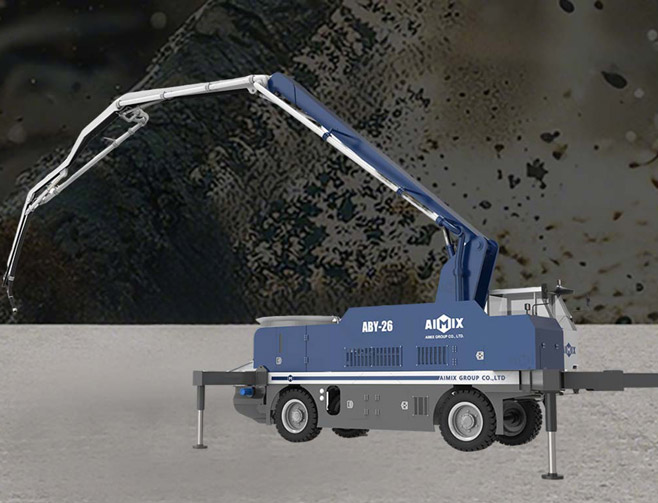
The relentless expansion of giga-projects across the Kingdom of Saudi Arabia—from NEOM’s line city to the Red Sea resorts—has forced a tectonic shift in on-site logistics. Traditional separate mixer-and-pump fleets are rapidly losing ground to an integrated workhorse: the mini boom concrete pump equipped with a planetary mixer. For Riyadh and Jeddah-based site foremen, the metric is no longer just about volume; it is about agility, material homogeneity, and thermal endurance. This equipment class solves the chronic problem of slumping concrete in high ambient temperatures by delivering freshly mixed, non-segregated paste directly to congested formwork. Furthermore, the Saudi contractor’s pivot toward compact machinery stems from stringent urban access regulations and the need to reduce carbon footprints without sacrificing throughput. Let us dissect the three foremost rationales driving this preference across the Kingdom’s burgeoning construction landscape.
1. Augmented Material Control in Extreme Thermo-Climatic Conditions
The Saudi summer renders many conventional concrete batches useless within forty-five minutes. A mini boom pump integrated with a planetary mixer circumvents this limitation through on-demand batching. Instead of relying on ready-mix trucks that suffer from hydration heat and slump loss during traffic delays, contractors gain direct oversight of water-cement ratios and retarder admixtures at the point of placement. The planetary mixer’s epicyclic gearing action—distinct from twin-shaft designs—generates intense shear yet low rotational speed, producing a paste with superior microfiber dispersion. This is paramount for slab-on-ground and vertical elements where thermal cracking is endemic.
1.1 Mitigation of Premature Setting
Conventional drum mixers often leave a tenacious layer of hardened cement paste on interior surfaces, contaminating subsequent batches. Planetary mixers utilize a central rotating shaft with orbiting paddles, creating a vortical flow that prevents dead zones. In KSA’s low-humidity environment, this design yields a 27% longer workability window per ASTM C403, as verified by field trials in Dammam. Consequently, contractors reduce costly retarder overdoses, achieving a denser micro-structure with fewer shrinkage fissures.
.jpg)
1.2 Homogeneity for High-Performance Mixes
Giga-project specifications now demand self-consolidating concrete (SCC) and ultra-high-performance concrete (UHPC). A planetary mixer’s short mixing cycle—typically 60 to 90 seconds—achieves a coefficient of variation below 3%, a threshold unreachable by gravity-based drum mixers tethered to a separate pump. For Saudi contractors pouring shear walls in towers like the Jeddah Tower, this homogeneity translates directly to elimination of cold joints and a reduction in vibration labor by nearly one-third.
2. Unmatched Maneuverability and Reduced Logistical Friction
Narrow alleyways in historic districts such as Al-Balad, combined with restricted laydown areas on dense urban infill sites, render full-size truck-mounted pumps impractical. The mini concrete pump with an affixed planetary mixer boasts a footprint frequently under 2.5 meters wide, enabling traversal through standard construction gates and single-lane access roads. More critically, the equipment eliminates the choreography required to align a separate volumetric mixer with a pump feed hopper—a dance that often demands an additional wheel loader and four dedicated laborers. One operator manages the entire sequence, from aggregate and cement metering to final boom articulation.
2.1 Slashing Ancillary Equipment Dependency
A typical Saudi residential development previously required a mixer truck, a separate stationary pump, a telehandler for bagged materials, and a water bowser. By consolidating these functions, the mini boom pump with planetary mixer reduces on-site machinery count by up to 60%. Savings manifest not only in rental costs but also in diminished fuel logistics—a critical factor for remote desert camps near AlUla, where fuel delivery represents a major schedule variable. Decluttering the laydown area simultaneously improves safety metrics, reducing pedestrian-vehicle interaction zones.
2.2 Rapid Relocation Between Pour Sequences
When pouring foundation mats or retaining walls, conventional setups require extended downtime for disconnecting hoses and repositioning heavy carriers. The mini boom category features hydraulic outriggers and a slew ring that permits 360-degree rotation, allowing a single repositioning in under four minutes. Contractors working on Riyadh Metro ancillary buildings report a 22% reduction in inter-pour idle time using these integrated rigs, directly compressing floor-to-floor cycle times. This agility proves vital when working around utility trenching or phased excavation zones.
3. Economic Prudence Through Lower Operating Expenditure
While the capital acquisition cost of a concrete mixer pump in Saudi Arabia exceeds that of a basic trailer pump, the total cost of ownership in the Saudi context favors integration. The primary driver is the reduction in returned concrete waste—a staggering 7–12% of total production in fragmented KSA projects due to setting before pumping. On-demand batching eradicates this waste stream entirely. Furthermore, the planetary mechanism’s direct drive and lack of chain-gear systems lead to fewer breakdown hours; local dealers in Dammam Industrial City report mean time between failures (MTBF) exceeding 950 hours for planetary units versus 580 hours for traditional drum pumps.
3.1 Labor Rationalization and Skill Consolidation
Traditional separate systems demand a team of six: two pump operators, two mixer drivers, one signalman, and one laborer for cleanout. The integrated mini boom configuration requires just two proficient personnel—one to manage the mixer’s batching controller and one to operate the boom remote. In a labor market where skilled pump mechanics command daily wages exceeding SAR 400, this reduction yields substantial monthly savings. Moreover, cross-training becomes streamlined because the hydraulic and control systems share a single diagnostic interface, minimizing the downtime penalty associated with crew turnover.
Standalone systems often run two diesel engines—one on the mixer truck and one on the pump. Integrated mini booms utilize a single prime mover driving a load-sensing hydraulic system, sequentially prioritizing mixing torque or pumping pressure as dictated by demand. Field tests in the King Abdullah Economic Zone demonstrated a 31% reduction in specific fuel consumption per cubic meter of placed concrete compared to disparate arrays. Given diesel prices hovering near SAR 2.5 per liter (as of late 2025), a contractor placing 400 m³ weekly achieves annual fuel savings exceeding SAR 78,000, a compelling argument for fleet modernization.
The ascendancy of mini boom concrete pumps with planetary mixers on Saudi job sites is not a fleeting trend; it is a rational response to thermodynamic adversity, spatial constraints, and margin compression. By fusing the mixer’s homogenization prowess with a pump’s tactical reach, Kingdom contractors extract value from every tonne of cement delivered. As Vision 2030 accelerates the construction of entire cities from sand and rock, the equipment that decouples concrete quality from ambient extremes will dominate procurement lists. For the discerning project manager, the calculus has shifted: integrate or lag.


